
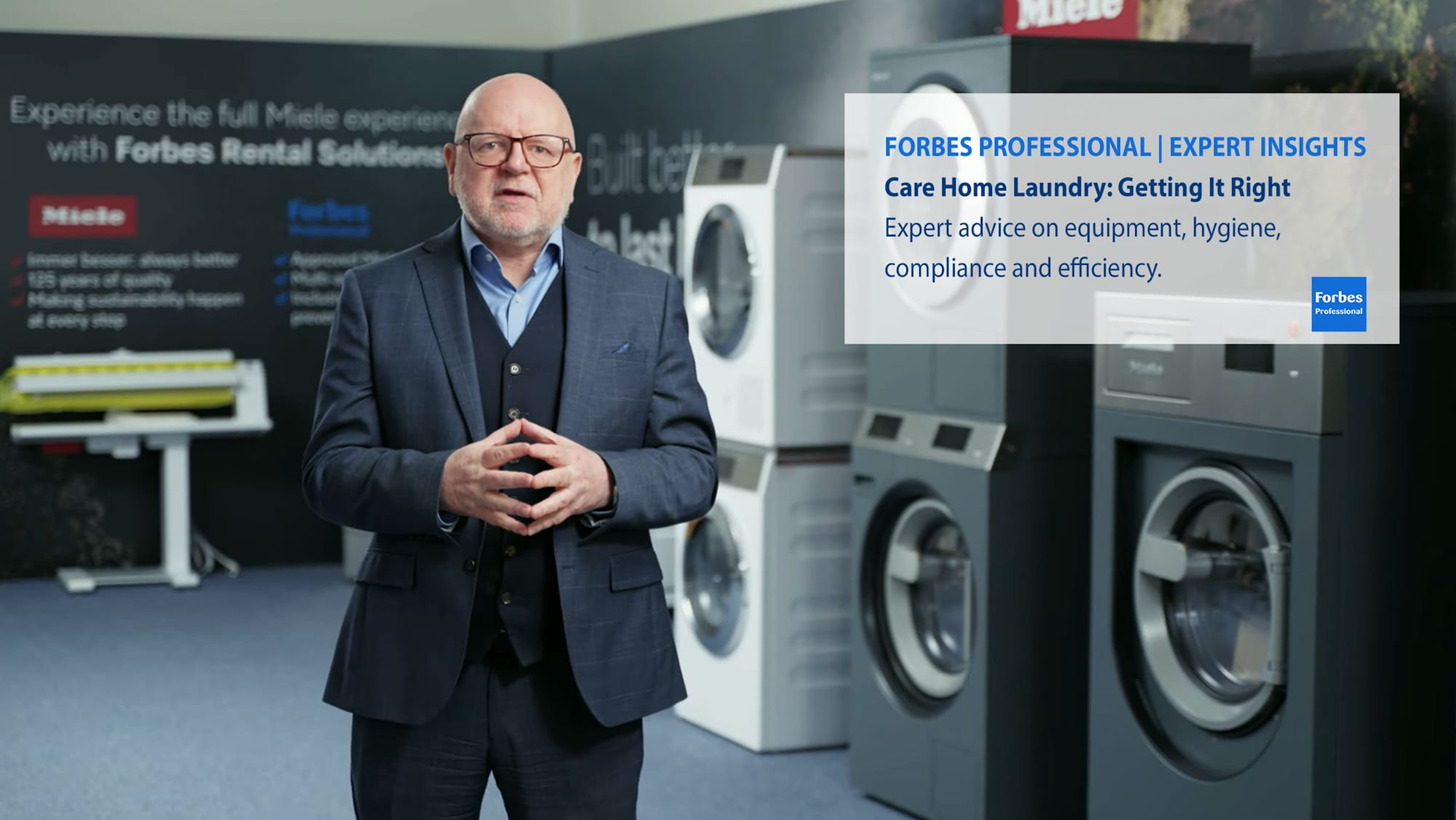
Choosing the Right Commercial Laundry Equipment for Your Care Home

Hannah Forbes
View all posts by this author →From infection prevention and regulatory compliance to efficiency and reliability, choosing the right laundry equipment is an important part of delivering safe, high-quality care.
In a busy care home, the laundry room rarely gets much attention — until something goes wrong. A broken washing machine, a backlog of bedding or uncertainty around infection control can quickly become a significant operational challenge.
Yet choosing the right commercial laundry equipment for a care home isn't simply about keeping up with the washing. It's about protecting residents, supporting staff and ensuring that essential hygiene processes run reliably, day after day.
The most suitable laundry solution combines appropriate machine capacity, validated disinfection programmes, suitable water-supply protection, effective detergent dosing and dependable servicing. Getting these elements right from the outset can make a significant difference to both daily operations and long-term costs.
Why the Right Equipment Matters
Care home laundries work hard. From residents' personal clothing and bedding to towels, uniforms and heavily soiled textiles, machines must cope with demanding workloads while maintaining consistent hygiene standards.
Domestic washing machines may appear to offer a cost-effective solution, but they are rarely designed for the continuous demands or specialist infection prevention requirements of a professional care environment.
Purpose-built commercial equipment offers greater durability, more precise programme control and, depending on the model, specialist sluice and thermal disinfection cycles.
However, choosing the right equipment isn't simply a question of buying the largest or most sophisticated machine. Capacity, available space, utility connections, laundry volumes and the needs of residents must all be considered.
A smaller residential home may have very different requirements from a large nursing home, particularly where significant volumes of contaminated laundry are processed each day.
Getting CQC and WRAS Compliance Right
Infection prevention and control is central to safe care, and laundry has an important role to play.
The Care Quality Commission (CQC) expects providers to demonstrate that appropriate procedures are in place to minimise infection risks. For laundry operations, this means considering everything from the segregation of clean and soiled textiles to effective disinfection, staff training and equipment maintenance.
Commercial washing machines with validated thermal disinfection programmes can help care homes achieve consistent hygiene outcomes. Specialist sluice cycles can also support the safe processing of heavily soiled laundry.
Water-supply protection is another consideration that should never be overlooked.
Care home laundry involving potentially contaminated textiles can present a Fluid Category 5 risk under the Water Supply (Water Fittings) Regulations. Where this applies, appropriate backflow prevention, typically incorporating a suitable air-gap arrangement, is required to protect the mains water supply.
It is important to understand that WRAS product approval and Fluid Category 5 protection are not interchangeable. Compliance depends on the equipment, the installation and the specific risks involved.
This is why professional advice and a thorough site survey are so valuable before investing in new laundry equipment.
As Hannah Forbes, Marketing Director at Forbes Professional, explored in her thought-leadership feature for Care Home Magazine (pages 28–29), laundry plays an often underestimated role in infection prevention, regulatory compliance and resident wellbeing.
Her article highlights why a professionally managed laundry should be regarded as an integral part of care, rather than simply a back-of-house function.
Further reading: Hannah Forbes' Care Home Magazine feature – Supporting Infection Control, Compliance & Efficiency in Care Homes
Choosing Equipment That Works for Your Care Home
With a wide range of commercial washing machines and tumble dryers available, understanding which equipment is best suited to a particular setting can be challenging.
Established manufacturers such as Miele, IPSO and Primus offer professional laundry solutions designed for demanding environments, with different capacities, wash programmes and operational features available across their ranges.
At Forbes Professional, we work with these trusted manufacturers to help care providers select equipment that meets their practical requirements. Our approach begins with understanding how the laundry operates: the volume of washing generated, the types of textiles being processed, the space available and the existing electrical, plumbing and drainage infrastructure. We also consider future requirements, energy and water consumption, drying capacity and the importance of keeping disruption to a minimum.
The aim is not simply to supply a laundry machine, but to create a reliable laundry solution that works efficiently within the home.
Why Automatic Detergent Dosing Makes a Difference
Even the most advanced commercial washing machine depends on the correct detergent and wash process to deliver effective results.
In busy care environments, where multiple staff members may operate the laundry, manual detergent dosing can lead to inconsistent quantities, unnecessary chemical consumption and variable cleaning performance.
Automatic detergent dosing systems help address these challenges by dispensing controlled quantities of compatible laundry chemicals at the appropriate stage of the wash cycle.
This can improve consistency, reduce manual chemical handling and provide better control over detergent usage and operating costs.
Forbes Professional supplies automatic dosing equipment alongside specialist laundry detergents, enabling care providers to benefit from a more integrated approach to laundry management.
When machines, wash programmes and chemicals are correctly matched, the result is a more consistent and efficient process that is easier for staff to manage.
Looking Beyond the Procurement Price
When investing in commercial laundry equipment, the initial product price is only part of the picture.
Energy and water consumption, detergent costs, maintenance requirements and the consequences of unexpected downtime all contribute to the true cost of ownership.
A machine that appears inexpensive initially may prove less economical if it struggles to meet daily demand or requires frequent repairs. Equally, correctly specified equipment can help improve efficiency, manage resources more effectively and reduce pressure on staff.
Taking a longer-term view helps care providers make informed decisions and invest in equipment that will continue to meet their needs.
The Importance of Reliable Nationwide Support
Even the most dependable commercial laundry equipment requires regular maintenance and occasional repairs. For care homes, a breakdown is rarely just an inconvenience. Laundry can quickly accumulate, staff workloads increase and essential hygiene routines may be disrupted.
Having access to experienced technical support is therefore just as important as choosing the right equipment.
Forbes Professional provides nationwide commercial laundry service and maintenance support, helping care providers keep their laundry operations running reliably.
From initial site surveys and installation through to commissioning, preventive maintenance and reactive repairs, our specialist teams support customers throughout the working life of their equipment.
For care groups operating across multiple locations, working with a single nationwide provider can also simplify maintenance arrangements and deliver greater consistency across their estate.
A Trusted Partner for Care Home Laundry
Choosing commercial laundry equipment is ultimately about finding the right balance between hygiene, compliance, efficiency and reliability.
It's also about choosing a supplier who understands the realities of running a care home and the importance of having dependable support when it's needed.
As a family business with more than a century of heritage, Forbes combines longstanding experience with specialist technical expertise and an award-winning commitment to customer service.
Working with leading manufacturers including Miele, IPSO and Primus, we provide tailored laundry solutions supported by automatic detergent dosing, specialist detergents and nationwide engineering expertise.
Our consultative approach means we take the time to understand each customer's requirements, offering practical guidance and ongoing support rather than simply supplying equipment. Because in a care environment, reliable laundry isn't just about clean linen. It's about supporting the people who provide care and protecting the comfort, dignity and wellbeing of those who receive it.
Frequently Asked Questions
What is the best commercial washing machine for a care home?
The most suitable commercial washing machine depends on resident numbers, laundry volumes, infection prevention requirements and available infrastructure. Professional machines from manufacturers such as Miele, IPSO and Primus offer different capacities and programme options to suit a range of care environments.
Do care homes need WRAS-compliant washing machines?
Care home laundry installations must meet applicable water regulations. Where a Fluid Category 5 contamination risk exists, suitable backflow protection is required. Equipment and installation arrangements should be assessed by a knowledgeable specialist.
Why is automatic detergent dosing beneficial in care homes?
Automatic detergent dosing delivers controlled quantities of compatible laundry chemicals, helping improve consistency, reduce manual handling and manage chemical consumption more efficiently.
How important is servicing for commercial care home laundry equipment?
Regular servicing helps maintain equipment performance, reduce unexpected breakdowns and support reliable day-to-day operations. Nationwide maintenance support can be particularly valuable for care groups operating across multiple sites.
Talk to Forbes Professional
Whether you're upgrading an existing laundry room, opening a new care home or reviewing equipment across multiple sites, Forbes Professional can help.
Our specialists provide practical advice, tailored equipment recommendations and ongoing nationwide support to help you create a safe, efficient and dependable laundry operation. Rental, purchase and maintenance options are all available.
Contact Forbes Professional today to arrange a specialist consultation or site survey.
